Seamless Apparel Market: A Revolution in Textile Engineering
The global apparel landscape is undergoing a structural transformation as “seamless” technology moves from a niche manufacturing technique to a dominant market force. Characterized by a lack of seams, stitches, and traditional construction lines, seamless garments are redefining the intersection of comfort, performance, and aesthetics.
Download a free sample copy of the Seamless Apparel market report to understand detailed coverage and inclusions in the final report
No credit card required*
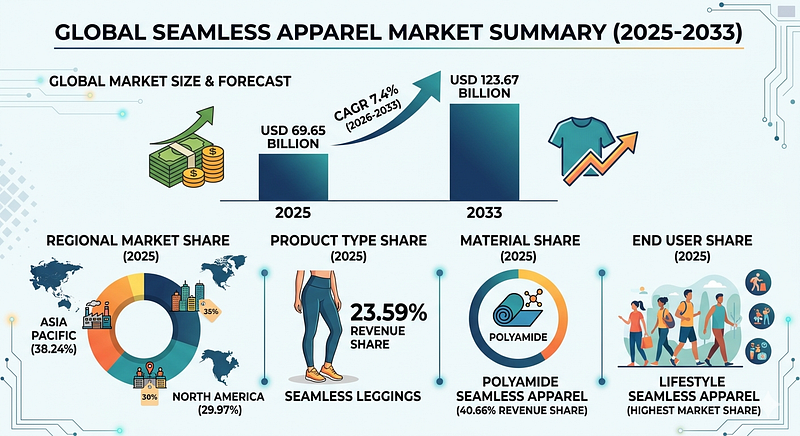
Market Evolution and Growth Drivers As of 2025, the seamless apparel market is valued at USD 69.65 billion. Over the next eight years, the sector is poised for aggressive expansion, reaching a projected USD 123.67 billion by 2033. This growth is fueled by a Compound Annual Growth Rate (CAGR) of 7.4% from 2026 to 2033.
The primary driver behind this surge is the shifting consumer preference toward “athleisure” and lifestyle wear. Unlike traditional cut-and-sew methods, seamless knitting technology allows for the creation of garments that move like a second skin. This reduces friction, enhances moisture management, and provides superior durability — qualities that are highly prized by both professional athletes and daily commuters.
Looking for more specific insights? Customize this report to suite your business needs
Regional and Material Insights In 2025, Asia Pacific emerged as the clear market leader, commanding a 38.24% revenue share. This dominance is attributed to the region’s massive manufacturing infrastructure and a growing middle class in countries like China and India. North America followed closely, representing 29.97% of the market, driven by high consumer spending on premium fitness brands.
Regarding materials, Polyamide (Nylon) remains the industry standard, accounting for 40.66% of the market share. Its popularity stems from its incredible elasticity and soft-touch feel, which are essential for seamless construction. Among product types, seamless leggings are the most sought-after item, representing nearly 23.59% of the total market revenue.
Trends Shaping the Future Several trends are converging to accelerate market adoption:
- Lifestyle Dominance: “Lifestyle” seamless apparel now holds the highest market share by end-user, as consumers increasingly wear seamless gear for social and professional settings, not just the gym.
- Sustainability: Seamless manufacturing produces significantly less fabric waste than traditional methods, aligning with the global push for eco-friendly fashion.
- Technological Integration: Advances in circular knitting machines allow for varied compression zones within a single garment without the need for seams.
Explore our Interactive market dashboard to get a bird’s-eye view of the Seamless Apparel Market. Perform cross-segment analysis, look at market numbers pertaining to specific segments, geographies & timelines, and download these data points in image format that can be used in decks and presentations.
Frequently Asked Questions (FAQ)
- Q: Why is Polyamide the preferred material for seamless apparel?
- A: It offers the perfect balance of durability, moisture-wicking capability, and extreme stretch, which is vital for garments that must maintain their shape without structural seams.
- Q: What is the projected market value by 2033?
- A: The market is expected to reach USD 123.67 billion, nearly doubling its 2025 value.
- Q: Which product is currently leading the market?
- A: Seamless leggings are the top-performing product category, making up 23.59% of the revenue share in 2025.
Looking for a report customized to your requirements? Explore our Custom Research Offering
Grand View Research offers
√ Focused market intelligence reports on specific geographies or high-growth segments.
√ Extended forecast timelines for long-term planning.
√ Competitor Benchmarking and Supply Chain Analysis
√ Inclusion of regulatory and policy assessments.
√ Inclusion of custom data models, KPIs, or applications unique to your business
√ Specific high-impact Data Decks and Tables to support effective decision making
And much more…