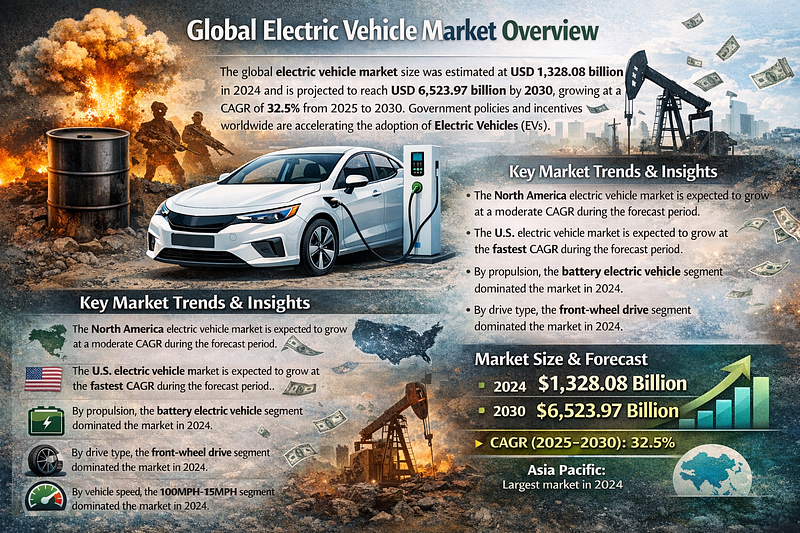
The global electric vehicle market is experiencing unprecedented growth as governments, industries, and consumers accelerate the shift toward sustainable transportation. According to recent market estimates, the EV market was valued at USD 1,328.08 billion in 2024 and is projected to reach USD 6,523.97 billion by 2030, expanding at an impressive compound annual growth rate (CAGR) of 32.5% from 2025 to 2030. This rapid expansion reflects the increasing urgency to reduce carbon emissions, decrease reliance on fossil fuels, and build resilient energy systems in an uncertain geopolitical environment.
Growing Government Support and Policy Push
Government policies remain one of the most powerful drivers of EV adoption worldwide. Many countries have introduced incentives such as tax credits, subsidies, purchase rebates, and stricter emission regulations to encourage the transition from internal combustion engine (ICE) vehicles to electric mobility. These initiatives are designed not only to reduce greenhouse gas emissions but also to stimulate domestic manufacturing and innovation in clean technologies.
For example, several governments are investing heavily in EV charging infrastructure, battery manufacturing ecosystems, and renewable energy integration. These measures are helping reduce range anxiety among consumers while improving the affordability and accessibility of electric vehicles. As a result, both developed and emerging economies are witnessing rapid increases in EV adoption rates.
Need deeper insights? Customize this report for your market
Didn’t find exactly what you need? Customize this report
Need specific data? Request a tailored version of this report
Asia Pacific Leads the Global Market
The Asia Pacific region emerged as the largest EV market in 2024, driven primarily by strong demand and large-scale production capabilities. Countries such as China, Japan, and South Korea have played a critical role in shaping the global EV ecosystem. China in particular has established itself as a global leader in electric vehicle manufacturing, battery technology, and EV supply chains.
Mass adoption in Asia Pacific is supported by government mandates, urban pollution concerns, and strong domestic manufacturing infrastructure. In addition, the region benefits from extensive investments in lithium-ion battery production, which remains a critical component of electric vehicle technology.
As battery costs continue to decline and energy storage technologies improve, EVs are becoming more competitive with traditional vehicles, further accelerating their adoption across the region.
Rapid Growth in the United States
While Asia Pacific dominates the global EV market, the United States is expected to register the fastest growth during the forecast period. Several factors are contributing to this rapid expansion, including government incentives, growing consumer awareness, and the expansion of EV charging infrastructure.
Major automakers in the United States are significantly increasing their investments in electric vehicle development. At the same time, the federal government and private sector are collaborating to expand nationwide charging networks, making EV ownership more convenient for consumers.
Additionally, corporate sustainability initiatives and fleet electrification programs are further driving demand. Many companies are transitioning their logistics fleets to electric vehicles to reduce operational costs and meet sustainability targets.
Battery Electric Vehicles Dominate the Market
Among propulsion technologies, battery electric vehicles (BEVs) currently dominate the global EV market. Unlike hybrid vehicles, BEVs operate entirely on electricity and do not rely on gasoline engines. This makes them particularly attractive from an environmental standpoint because they produce zero tailpipe emissions.
Advancements in battery technology have significantly improved the performance and affordability of BEVs in recent years. Modern electric vehicles now offer longer driving ranges, faster charging times, and improved reliability compared to earlier generations.
In addition, economies of scale in battery production have helped reduce costs, making electric vehicles more accessible to a broader range of consumers. As battery innovation continues, BEVs are expected to remain the leading propulsion segment in the EV market.
Front-Wheel Drive and Vehicle Performance Trends
From a drivetrain perspective, front-wheel drive (FWD) electric vehicles dominated the market in 2024. This configuration is widely used because it offers several advantages, including lower manufacturing costs, improved energy efficiency, and better performance in urban driving conditions.
In terms of performance, the 100 MPH to 125 MPH vehicle speed segment accounted for a large share of the market. This speed range represents the ideal balance between performance and energy efficiency for most passenger vehicles.
Manufacturers are focusing on delivering vehicles that provide strong performance while maintaining high efficiency and extended battery range. This balance is essential for attracting mainstream consumers who expect electric vehicles to match or exceed the capabilities of conventional cars.
Crude Oil Prices and the Shift Toward Electric Mobility
One of the most important macroeconomic factors influencing EV adoption is the volatility of global crude oil markets. Oil prices have historically been influenced by geopolitical tensions, supply disruptions, and conflicts in energy-producing regions. These uncertainties often lead to sudden increases in fuel prices, placing financial pressure on consumers and businesses.
When gasoline and diesel prices rise, electric vehicles become significantly more attractive from a cost perspective. EV owners benefit from lower operating costs because electricity is generally cheaper and more stable in price compared to fossil fuels.
Moreover, countries that rely heavily on imported oil are increasingly viewing electric mobility as a strategy to enhance energy independence. By shifting transportation systems toward electricity, nations can reduce their vulnerability to global oil market fluctuations.
Geopolitical Conflicts and Energy Security
Global conflicts and geopolitical tensions have also highlighted the risks associated with fossil fuel dependence. Disruptions in oil supply chains can create economic instability and increase transportation costs across multiple industries.
In response, many governments are accelerating investments in renewable energy and electric transportation infrastructure. Electric vehicles play a key role in this strategy because they can be powered by domestically generated electricity from renewable sources such as solar and wind.
This transition not only supports climate goals but also strengthens national energy security by reducing reliance on imported fuels.
Technological Innovation Driving the Market
Technological advancements are another major factor contributing to the growth of the EV market. Innovations in battery chemistry, energy density, and charging technology are making electric vehicles more practical and appealing to consumers.
Fast-charging technologies are enabling vehicles to recharge significantly faster than before, while improvements in battery durability are extending vehicle lifespans. At the same time, advancements in vehicle software, connectivity, and autonomous driving systems are further enhancing the value proposition of electric vehicles.
Automakers are also experimenting with new battery technologies such as solid-state batteries, which promise higher energy density and improved safety compared to conventional lithium-ion batteries.
Expanding Charging Infrastructure
The expansion of EV charging infrastructure is another critical factor supporting market growth. Governments and private companies worldwide are investing in public charging stations, highway fast chargers, and residential charging solutions.
A robust charging network helps eliminate range anxiety and makes EV ownership more convenient. As infrastructure continues to expand, consumers are becoming more confident in transitioning to electric vehicles.
Get data tailored to your market — Explore custom research services by Grand View Research
Future Outlook
Looking ahead, the electric vehicle market is expected to remain one of the fastest-growing segments within the global automotive industry. Strong policy support, technological innovation, and growing environmental awareness will continue to drive adoption.
At the same time, global energy dynamics — including crude oil price volatility and geopolitical conflicts — are reinforcing the importance of transitioning toward cleaner and more resilient transportation systems.
By 2030, electric vehicles are expected to become a mainstream transportation option worldwide. As battery technology improves and production scales increase, EVs will likely achieve cost parity with conventional vehicles, accelerating the global shift toward sustainable mobility.
In this evolving landscape, electric vehicles are no longer just an environmental solution — they represent a strategic transformation of the global transportation and energy ecosystem.
Request Industry-Specific Customization with custom research services by Grand View Research
